

Why “Posting Consistently” Was Killing His Pipeline (And The Exact Repositioning System That Generated $18k in Retainers)
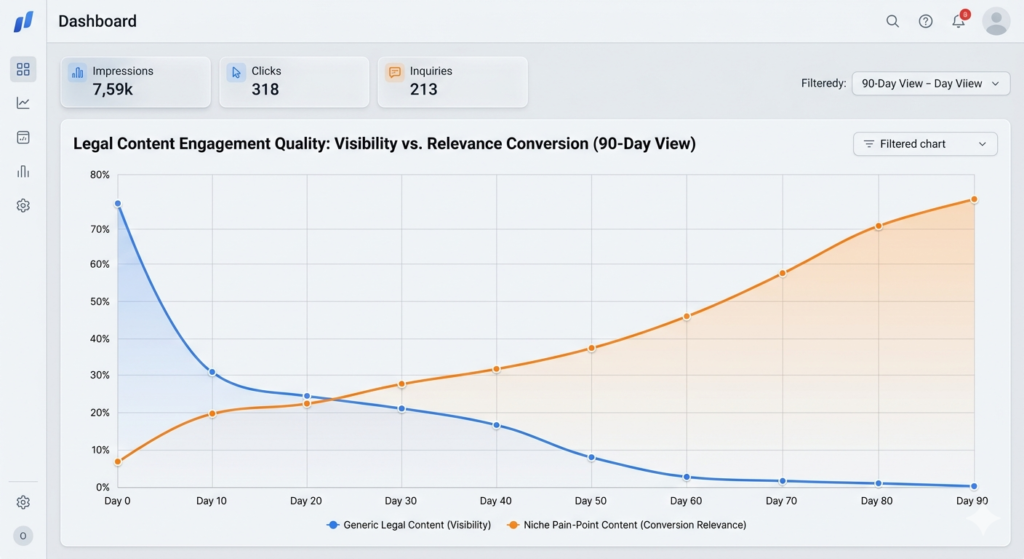
Most solo attorneys operate under a dangerous misconception: they believe that visibility equals viability. They assume that if they show up, post enough times, and share their legal expertise, the clients will follow.
They are wrong.
Visibility without specificity is just noise. And in the legal market, noise is expensive. It costs you time, energy, and ultimately, revenue.
Consider “Attorney J” (a pseudonym for a real client). J is a sharp, experienced litigation lawyer billing $350 per hour. For three months, he did everything the generic marketing gurus told him to do. He posted three to four times a week. He shared updates on case law. He posted holiday greetings. He engaged with other lawyers’ content.
The result? Zero paying clients from LinkedIn in 90 days.
He had likes. He had comments from former law school classmates. He had impressions. But his bank account remained stagnant, and his pipeline was empty.
This case study is not about how to post more. It is about how to change who sees you and what they see when they arrive. It is the story of how we moved J from invisible generalist to retained specialist in exactly 60 days, generating $18,000 in new retainer revenue without increasing his posting frequency.

The Problem: The “Generalist Trap” & Authority Dilution
J was not failing because he lacked skill. He was failing because he was trapped in the Generalist Trap.
By trying to appeal to everyone, he appealed to no one. His LinkedIn presence suffered from three critical structural failures that are common among solo practitioners.
1. Identity Crisis
J’s headline read: “Litigation Attorney at [Firm Name].”
To a potential client, this headline is meaningless. “Litigation” covers everything from divorce to corporate IP disputes.
When a prospect reads “I do everything for everyone,” their brain interprets it as “I am not an expert in my specific problem.”
In a crowded digital marketplace, generalists are invisible.
2. The Peer Echo Chamber
Because J’s content was broad, sharing general legal news and thoughts on “justice” it attracted the only people who care about general legal news: other lawyers.
His comment section was filled with peers debating procedural nuances. While intellectually stimulating, these individuals are competitors, not clients. J was building an audience of people who would never hire him.
3. A Passive Profile
J’s profile functioned as a digital resume. It listed his education, his bar admissions, and his past job titles.
It answered the question, “Who is J?”
It failed to answer the only question a potential client cares about:
“How does J solve my specific, urgent pain?”
The Human Cost
The emotional toll on J was significant. He described the experience as “shouting into a void.” Every morning, he would check his notifications with a spike of anxiety, hoping for a lead.
Instead, he’d find a congratulatory comment from a colleague on a post that took him two hours to write.
He was busy. He was creating content. But he was starving for revenue.
Agitation: The High Cost of Being “Just Another Lawyer”
The danger of this approach isn’t just that it fails to generate leads. It actively harms your practice.
The Opportunity Cost
Every hour J spent drafting a generic post about “The Importance of Due Process” was an hour he wasn’t billing to a client, refining his case strategy, or resting.
At $350/hour, the cost of ineffective marketing is tangible.
The Feast-or-Famine Cycle
Without a predictable inbound stream, J was forced into reactive business development. He relied on stressful, last-minute networking events or expensive PPC ads that sent traffic to a website that didn’t convert.
This created a cycle of anxiety:
when work dried up, he panicked; when work peaked, he ignored marketing, ensuring the next dry spell.
The Trust Deficit
When a high-stakes client—such as a SaaS founder facing an IP lawsuit—lands on a generic profile, they bounce.
They do not feel understood. They feel like just another case number.
The hard truth is this:
If you look like every other lawyer, you must compete on price.
Solo attorneys cannot win a price war against big firms with massive overhead. You must win on specialized authority.
The Solution: The “Conversion-First” Repositioning System
We did not ask J to post more. We asked him to post differently.
Over 60 days, we implemented a four-step Positioning Architecture. This system shifted J’s focus from broadcasting information to facilitating conversations with ideal clients.
Step 1: The Profile Pivot (From Resume to Landing Page)
Your LinkedIn profile is not a CV. It is a sales landing page.
Its sole purpose is to convince a specific visitor that you understand their problem and have a proven solution.
The Execution
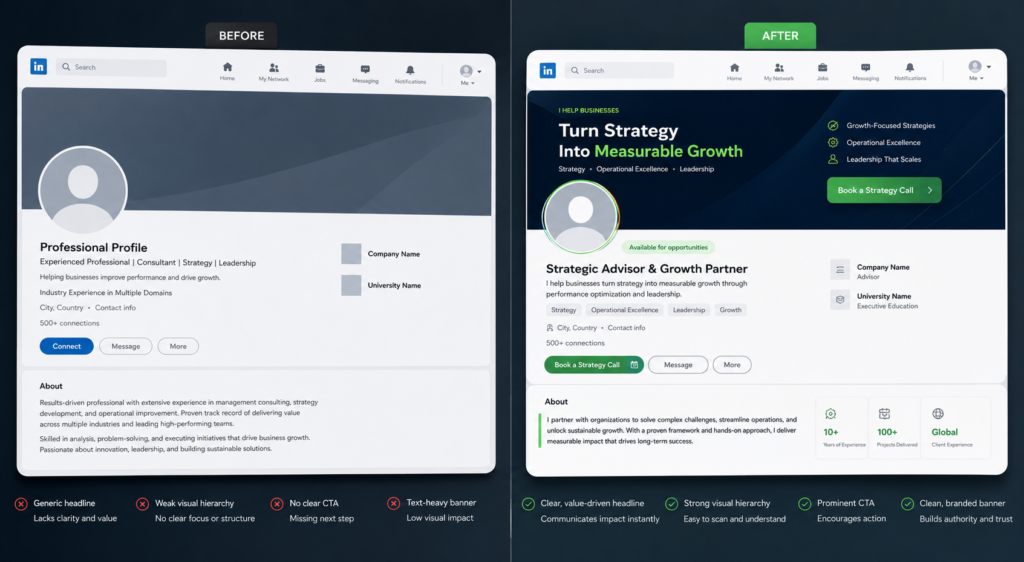
1. The Headline Rewrite
We stripped away the generic title. We replaced it with a benefit-driven statement that identified the niche, the problem, and the outcome.
Before: Litigation Attorney at J Firm
After: Helping SaaS Founders Resolve IP Disputes Without Derailing Series A Funding | Commercial Litigation Specialist
2. The Banner Image
We removed the stock photo of a gavel and scales. In its place, we designed a clean graphic with a clear value proposition:
“3 Steps to Protect Your IP Before You Scale.”
3. The About Section
We rewrote the bio using the PAS Formula (Problem-Agitation-Solution):
Problem: “You’ve built a proprietary algorithm, but your co-founder just left to start a competing firm.”
Agitation: “Without immediate action, you risk losing investor confidence and stalling your Series A round.”
Solution: “I help tech founders secure their IP assets through strategic litigation and cease-and-desist enforcement, allowing you to focus on growth, not legal threats.”
Step 2: The Content Framework (Case Outcome Storytelling)
J stopped sharing legal news. Instead, he began sharing Client Pain Scenarios.
We developed three content pillars designed to trigger recognition in his ideal client.
The 3 Pillar Clusters
Case Breakdowns (Anonymized):
Example: “How we stopped a cease-and-desist letter from shutting down a startup’s launch.”
Focus: The strategy and the relief provided, not just the statute cited.
Client Pain Scenarios:
Example: “The 3 signs your co-founder agreement is a ticking time bomb.”
Focus: Agitating the problem before offering the solution. This makes the reader feel “seen.”
Legal Consequences Explainer:
Example: “Why ignoring this one clause in your term sheet could cost you $50k in damages.”
Focus: Educating on risk. Fear of loss is a stronger motivator than hope of gain.
Sample Post Structure
Hook: “Your IP is your valuation. But most founders leave it unprotected until it’s too late.”
Story: “Last month, a client came to me 48 hours before their funding close. An ex-employee claimed ownership of the core code. The investors paused. The clock ticked.”
Lesson: “We didn’t sue. We negotiated a rapid assignment agreement based on prior employment contracts. The deal closed on time.”
Soft CTA: “Don’t wait for the threat. Comment ‘IP CHECK’ below, and I’ll send you my 5-point Founder’s IP Audit Checklist.”
Step 3: The Activation Engine (Comment-to-DM System)
This was the most critical shift. J stopped waiting for inbound DMs. He created a Lead Magnet within the comments section of his posts.
The Workflow
The Trigger: Every post ended with a specific, low-friction offer. “Comment ‘IP CHECK’ and I’ll send you my 5-point Founder’s IP Audit Checklist.”
The Delivery: When a user commented, J sent a personalized DM with the PDF checklist.
The Follow-Up: 24 hours later, J sent:
“Hi [Name], did the checklist help? I noticed you’re in SaaS—do you have current counsel reviewing your term sheets?”
The Conversion: This question shifted the conversation from “free advice” to “discovery.”
If they said no, J offered a brief 15-minute audit call.
(Insert Image: Flowchart: Post → Comment → DM with Value → Qualification Question → Call Booking.)
Step 4: Strategic Outreach (The “Warm” Approach)
J spent 15 minutes a day engaging with his ideal clients, not his peers.
He identified 20 SaaS founders and CTOs in his network. He commented on their posts, adding value without pitching.
Example:
“Great point. Make sure your employment contracts include clear IP assignment clauses to avoid this later.”
This increased his visibility in their feeds. When he eventually sent a DM, it felt familiar, not cold.
Human Element: The Shift from “Performer” to “Partner”
Previously, J felt like a performer on a stage.
Now he felt like a partner in a conversation.
LinkedIn stopped being a marketing chore and became a structured client acquisition system.
Results: The Numbers Don’t Lie
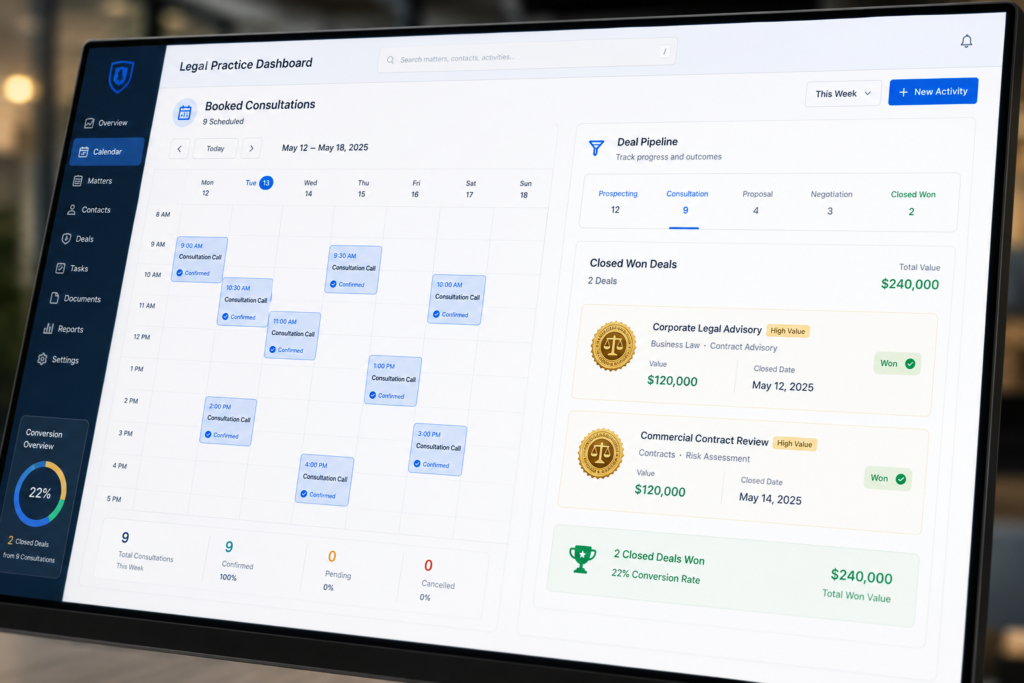
The 60-Day Snapshot
- Inquiries: 0 → 9 Qualified Leads
- Conversion Rate: +280%
- Engagement Quality: 1.2% → 6.8%
- Revenue: $18,000+ in retainers
- Time Saved: 50% reduction in content creation time
Conclusion & Next Steps
You do not need more followers. You need better positioning.
You do not need viral posts. You need a conversion architecture.
The growth path is not visibility. It is clarity + specificity + system.
Ready to Fix Your Pipeline?
Option 1: The DIY Audit
Download our free “LinkedIn Profile Audit Checklist for Lawyers”
Option 2: The Strategic Partnership
Book a 15-minute Strategy Audit. We will review your profile, identify your niche opportunity, and map out a custom 60-day plan.