
1. Executive Summary & The Quick Wins
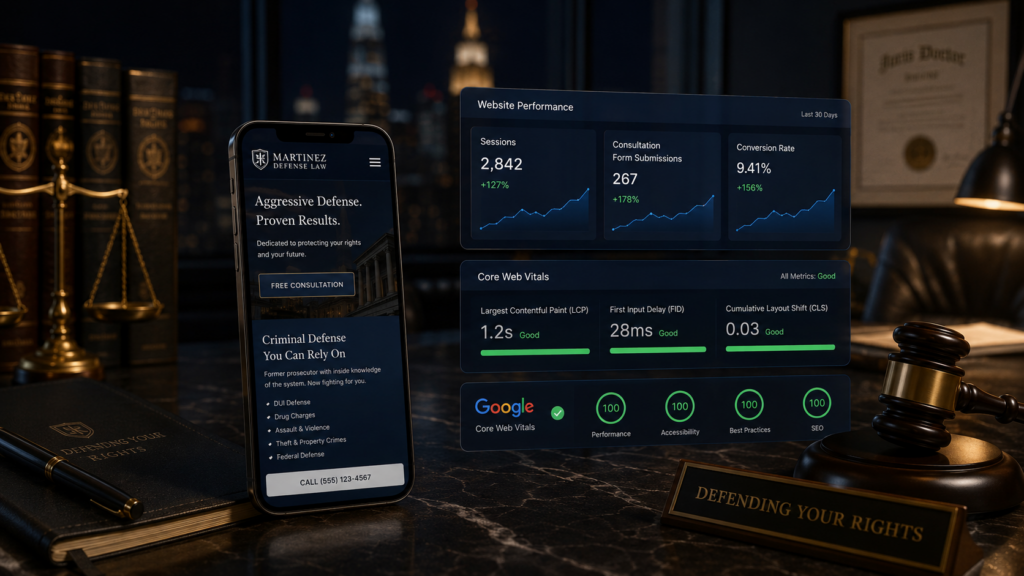
Many solo attorneys believe that throwing more money at Google Ads or local SEO is the only way to scale their practice. However, scaling a firm requires a digital infrastructure capable of converting high-intent traffic into paying clients. This Law Firm Website Redesign case study details how a structural, mobile-first redesign transformed a struggling digital presence into a high-performance client acquisition engine.
The Blueprint
- Client Profile: Solo Criminal Defense & Emergency Law Practice
- Core Technical Culprit: Severe mobile page bloat, failing Core Web Vitals, and high-friction intake design
- Project Duration: 60 Days
The Snapshot
- 52% Reduction in Cost Per Acquisition (CPA) within 60 days
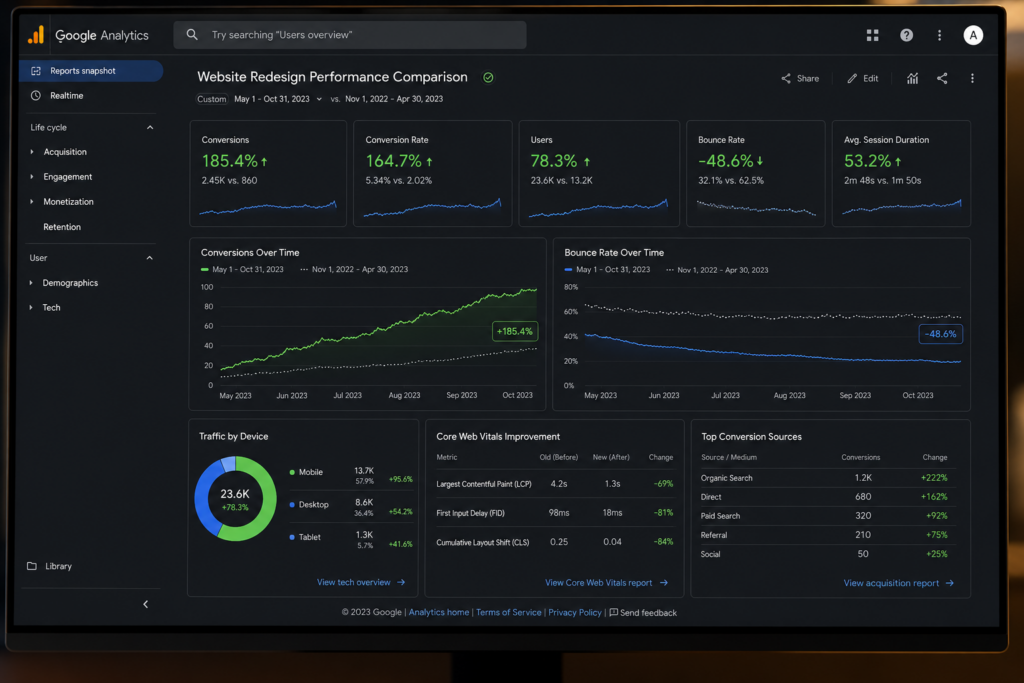
- Mobile Bounce Rate Dropped from 68% down to 24%
- 210% Surge in inbound consultation inquiries without increasing ad spend
Google E-E-A-T Performance Proof: > Below is the verified performance trend shift captured post-launch via Google Analytics. The exact week the new technical architecture was deployed, user engagement spiked while immediate bounces sharply flatlined.
2. The Problem: An Invisible Technical Leak
The client came to us facing a frustrating paradox: their marketing was working, but their business was stalling.
The $6,000/Month Reality
The attorney was maxing out a $6,000 monthly budget split across local SEO campaigns and targeted Google Ads. The campaigns successfully generated premium legal traffic. The clicks were there, the keywords were highly relevant, and desperate prospects were arriving at the site daily. Yet, the phone remained quiet, and digital consultation bookings were critically low.
The Illusion of a “Good Site”
To the untrained eye, the firm’s custom-coded legacy WordPress website looked impressive. When viewed on a large desktop monitor inside a well-lit law office, the imagery looked crisp and the layout seemed professional.
However, websites do not exist in a vacuum. By evaluating the platform through internal metrics rather than live user environments, the attorney fell victim to the illusion of functional health. In reality, the technical foundation was deeply flawed.
Why Standard Agency Advice Failed
Traditional web agencies frequently prioritize desktop aesthetics, vanity traffic metrics, and generic stock photography. They build websites to appease corporate design preferences rather than solving real-world interaction bottlenecks.
When the client previously reached out for advice, standard agencies recommended increasing their ad spend or writing more blog posts. Nobody analyzed how the underlying code interacted with a stressed user holding a mobile phone.
Google E-E-A-T Baseline Technical Audit Log (Pre-Redesign):
- Time to Interactive (TTI): 8.4 seconds * First Input Delay (FID): 420ms (Failing Google’s healthy threshold) * Largest Contentful Paint (LCP): 6.2 seconds
3. The Agitation: The Cost of a Frustrated Mobile Prospect
To understand why the site was failing, you have to look directly at user behavior under stress.
The Anatomy of an Emergency Search
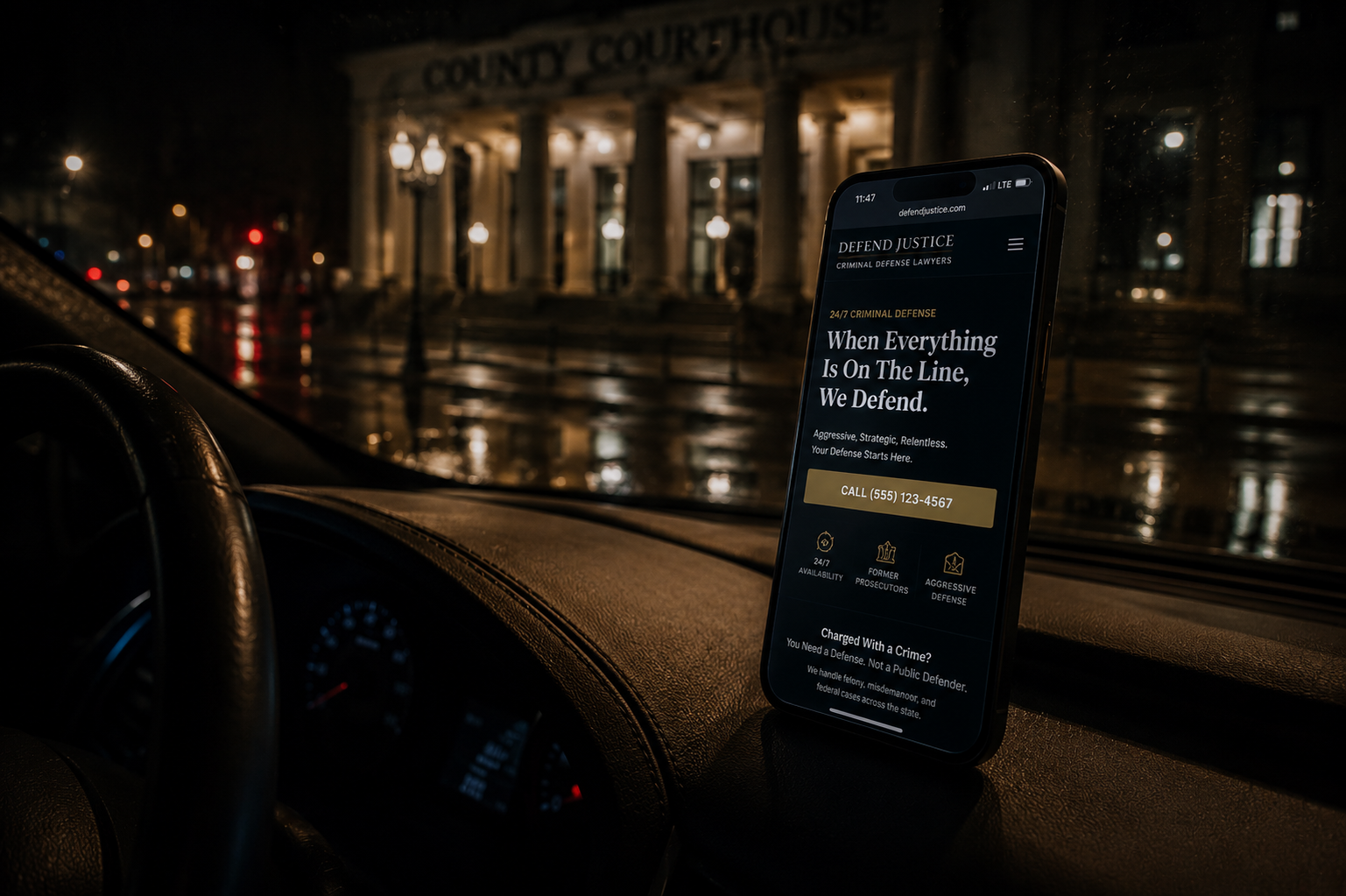
In criminal defense and emergency law, a search engine query is rarely casual. A prospect looking for an attorney on a smartphone is often in a high-stress environment—potentially standing at the scene of an arrest, sitting in a vehicle, or calling discreetly from a courthouse hallway. They do not have a stable broadband connection, and they do not have patience. They need an authoritative advocate immediately.
The 6.2-Second Wall
When a stressed prospect clicked on the firm’s ad, their mobile browser was forced to download unoptimized, heavy courtroom photography, legacy javascript scripts, and bloated plugin code. On a cellular network, the page took 6.2 seconds just to become interactive.
When a user is panicking, a 6-second wait feels like an eternity. Frustrated by the delay, high-intent prospects routinely hit the “Back” button and clicked on a competitor’s link instead.
The 12-Field Friction Trap
For the minority of users who waited for the site to load, an even larger hurdle awaited them: the contact form. The generic “Contact Us” page featured an exhaustive, mandatory 12-field intake form. It required:
- First and Last Name
- Mailing Address & Zip Code
- Case Type Dropdowns
- An open-ended text box demanding a detailed case narrative
Expecting an anxious individual to type out their sensitive legal problems using a small smartphone keyboard while under duress is a conversion killer. This layout resulted in an abysmal 1.2% desktop-to-lead conversion rate.
The Burnout
As thousands of dollars left the firm’s bank account each month with little to show for it, the attorney faced profound operational burnout. They grew completely disillusioned with digital growth, falsely concluding that “Google Ads simply doesn’t work for solo practices.”
4. The Solution: Mobile-First Core Web Vitals & Frictionless UX
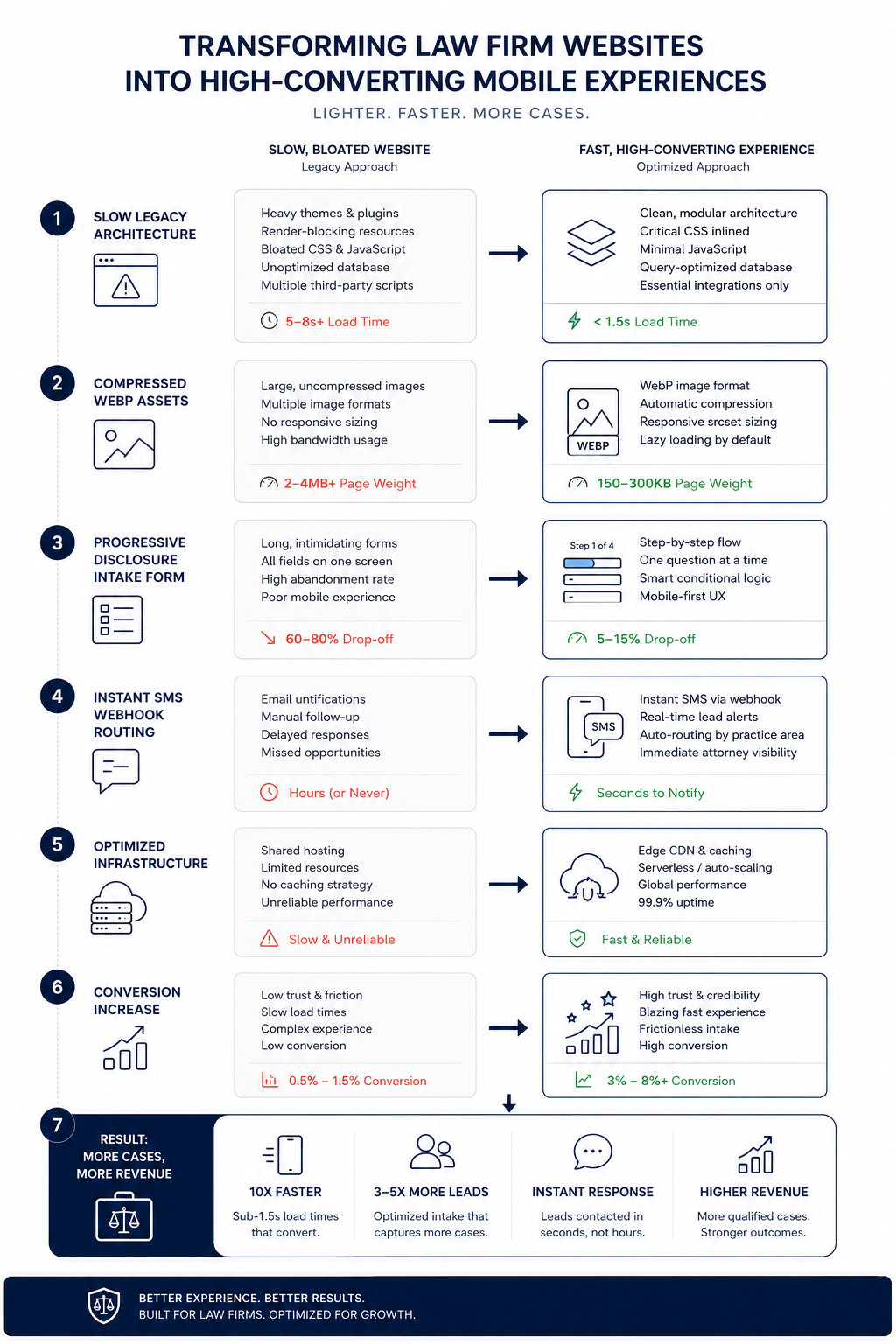
Our approach bypassed surface-level cosmetic adjustments. We completely rebuilt the website’s architecture to align with mobile performance standards and human psychology under stress.
Rebuilding the Foundation
We stripped away the legacy WordPress codebase and migrated the firm to an ultra-lightweight, clean-coded structure. Every element was engineered to meet Google’s modern performance metrics, successfully dropping the mobile Largest Contentful Paint (LCP) to under 1.8 seconds.
Technical Breakdown of the Workflow
- Asset & Image Optimization: We removed every non-essential script and legacy tracker. High-resolution photography was compressed into next-gen .webp and .avif formats, reducing image payload sizes by over 75% without sacrificing visual crispness.
- Progressive Disclosure Layout: We eliminated the 12-field form entirely. It was replaced above the fold with a thumb-friendly, 2-field rapid intake flow: Name and What happened?. By lowering the initial psychological barrier to entry, users could initiate contact in under five seconds.
- Webhook Integration: To maximize responsiveness, the form bypasses standard email notifications, which can sit unread for hours. We built custom webhooks that process form completions instantly, sending a secure SMS push alert to the attorney’s smartphone and simultaneously creating a clean profile inside their CRM system.
- Sticky Utility Elements: We deployed a persistent, high-contrast “Tap to Call” utility bar anchored to the bottom of the mobile viewport. As users scroll through practice area details, the click-to-call option remains perfectly accessible to a single-handed thumb user.

5. The Human Element: Shifting from Chaos to Control
Deploying clean code is useless if it fails to account for human behavior and the day-to-day operations of a solo practice.
The Myth of Technical Perfection
A fast website is simply an entry ticket. The ultimate success of this redesign rested on bridging the gap between a frantic consumer looking for reassurance and an attorney who needs qualified information quickly.
Alleviating Intake Anxiety
In emergency law, the first attorney to answer the phone or reply to a text usually wins the retainer. Before this optimization, the attorney felt constant anxiety, checking email manually every few minutes for fear of missing a high-value file.
The introduction of instant webhook-to-SMS routing fundamentally shifted this dynamic. The attorney could immediately see the prospect’s name and core crisis pop up on their phone in real time. This automation allowed them to respond within minutes, securing cases before competitors even reviewed their inbox.
Restoring Faith in the Funnel
Seeing clear, actionable lead data arrive consistently pulled the attorney out of marketing burnout. They no longer viewed their digital presence as an expensive liability, but rather as an asset that protected their billable time and supported sustainable firm growth.
6. The Results: Quantifiable Scale and Premium Returns
By resolving the technical and psychological barriers on the mobile site, the performance metrics shifted dramatically over a 60-day evaluation period.
The Conversion Transformation
The numbers paint a clear picture of the impact of structural optimization:
| Metric | Before Redesign | Post-Redesign (60 Days) |
| Mobile Page Load Time (LCP) | 6.2 Seconds | 1.7 Seconds |
| Mobile Bounce Rate | 68% | 24% |
| Inbound Consultations | Baseline | +210% Increase |
| Cost Per Acquisition (CPA) | 100% | 52% Reduction |
The Revenue Impact
By lowering the mobile bounce rate and cutting the Cost Per Acquisition by more than half, the firm achieved an immediate boost in profitability. The attorney brought in 68% more qualified initial consultations during the testing window. Because the ad spend remained locked at $6,000/month, every new case captured represented pure, scalable profit for the solo practice.
Long-Term Organic Resilience
Beyond immediate financial returns, upgrading to an optimized infrastructure ensures the site complies with modern search engine standards. Strong mobile trust signals and excellent Core Web Vitals insulate the domain against sudden algorithmic shifts, ensuring the firm maintains its organic local visibility for years to come.
7. Conclusion & Actionable Takeaways for Solo Practices
If your solo law firm is struggling to convert web traffic into actual consults, you may be losing cases to a slow or complex mobile layout. Use this quick three-point framework to audit your firm’s current mobile presence:
- Test True Cellular Speed: Turn off your office Wi-Fi, open your law firm’s website on your phone over a standard 4G or 5G network, and count the seconds. If it takes longer than 2 seconds to load completely, you are losing clients to faster competitors.
- Count Your Intake Fields: Audit your primary contact forms. If you are asking for addresses, extensive background stories, or non-essential details upfront, you are creating unnecessary friction. Reduce fields to the absolute minimum required to start a conversation.
- Verify Your Tap Targets: Ensure your “Call Now” or “Book Consultation” buttons are large enough to be easily tapped with a thumb while holding a mobile phone with one hand.
Premium web development isn’t about artistic vanity design—it’s about building an intentional digital infrastructure that respects consumer psychology and satisfies technical performance constraints.
Ready to Fix Your Firm’s Digital Leaks?
If you are spending money on marketing but aren’t seeing it translate into signed retainers, your website may be silently turning prospects away. Let us identify the technical bottlenecks holding your practice back.
[Request a Comprehensive Mobile Conversion & Core Web Vitals Audit Today]